Kitchen counters rarely become cluttered because of one enormous appliance. They fill up one small item at a time: the coffee scoop, a charging cable, two oil bottles, a blender cup, and the cutting board nobody puts away.
I used to clear my counter by pushing everything into a cabinet. It looked tidy for one day. Then I opened the door, found a leaning stack of pans, and pulled half the shelf out with it. The better fix was to give the things I use every day a small, obvious home.
Start with the jobs your counter has to do
Watch the kitchen during one normal morning before buying organizers. Notice where you set groceries, where you chop, where you charge a scale, and where dirty dishes wait. Repeated actions tell you what kind of storage will help.
My counter needed three landing spots: a clear prep area beside the sink, a narrow place for cooking oils near the range, and a small drop zone for keys and mail that kept wandering into the food-prep area. I did not need a bigger kitchen. I needed fewer items crossing the same workspace.
- Daily tools: keep them within one arm’s reach.
- Weekly tools: store them where one drawer opening gets them out.
- Rare tools: move them away from prime counter and cabinet space.
1. Protect one clear prep zone
Pick one section of counter for chopping and mixing. Keep it about as wide as your largest cutting board, then protect it from permanent storage. A board that slides around a toaster is not a prep zone; it is a daily obstacle course.
I keep a thin wood board upright in a slot beside the refrigerator. It is easier to grab than a board buried under pans, and it dries properly instead of trapping moisture against the counter. A letter sorter or narrow tray can do the same job if it is deep enough to keep the board stable.
2. Use the wall for only the tools you reach for
Vertical storage helps when it holds a short list of tools. A rail filled with every spatula you own only moves visual clutter from the counter to the wall. I prefer four or five hooks for awkward drawer items: a ladle, whisk, kitchen shears, and small sieve.
Check the wall before drilling. Tile needs a suitable bit and slow pressure, while drywall needs an anchor matched to the load. A removable adhesive hook can hold a light utensil in a rental, but I would not hang a cast-iron pan from one.
3. Give small appliances a parking place
Small appliances are hard to store because their cords and accessories multiply. I solved this by choosing one appliance to live on the counter and making the rest earn their return. My kettle stays out; the blender goes in a lower cabinet unless I am using it several times that week.
Measure the shelf before moving an appliance. Leave room for your hand above the lid and some space behind the plug. A tight shelf turns breakfast into a wrestling match, and repeatedly yanking a cord by the cable can damage the strain relief.
4. Turn one drawer into a tool station
A shallow drawer can hold more than a loose pile if you divide it by task. I use one section for measuring spoons, one for peelers and small graters, and one for clips and ties. The dividers are low enough that I can see the handles without digging.
Measure the drawer box, not the cabinet opening. Drawer slides and inside faces can steal more width than you expect. I learned this after buying a bamboo organizer that was three millimeters too wide; sanding it was possible, but returning it would have been smarter.
5. Contain oils and seasonings near the range
Cooking oils belong near the range, but the area beside the burners becomes sticky fast. A narrow washable tray keeps bottles from spreading across the counter. Lift the tray to wipe beneath it instead of cleaning around every bottle.
Keep heat-sensitive oils, spices, and plastic squeeze bottles away from a hot burner or oven vent. I once left a silicone bottle too close to a cast-iron pan, and the softened cap never sealed properly again. A few inches of clearance prevents a cheap storage solution from becoming a mess.
6. Make the coffee and tea routine movable
If the same three items appear every morning, a tray can make them look intentional. Put the scoop, filters, tea clips, and sweetener on a tray narrower than your workspace. When you need the counter for cooking, move the whole group instead of ten individual items.
Choose a tray with a lip but not a deep bowl. A deep tray hides crumbs and makes small pieces hard to pick up. I like washable plastic or sealed wood because coffee grounds find every rough edge.
7. Use the space under cabinets carefully
Under-cabinet space can hold lightweight items such as paper towels, a small cookbook stand, or a magnetic strip for measuring spoons. It is also useful for a folding phone stand if you follow recipes there.
Do not screw into the cabinet bottom without checking its construction. Some cabinets have a thin finished panel over a hollow space. Use short screws that cannot poke through, or choose a clamp-on solution.
8. Put scrap storage beside the cutting board
A counter gets cluttered when every peel has to travel across the room. A small compost bowl or scrap container beside the cutting board keeps waste together. Empty it after prep instead of letting it become a second sink.
I use a stainless bowl because it does not hold smells and can go into the dishwasher. If you use a container with a lid, make sure it opens with one hand. A two-handed lid creates just enough friction to make a system fail.
9. Store trays and boards vertically
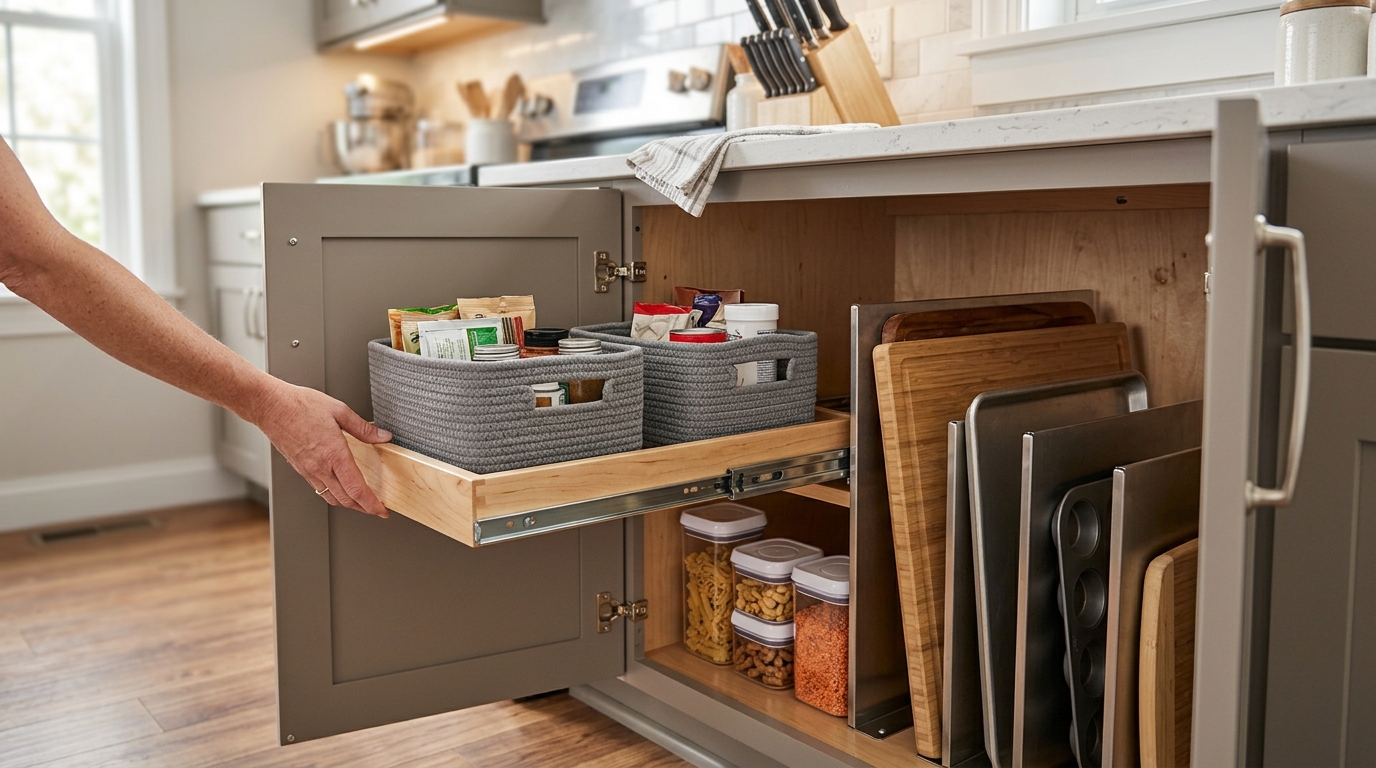
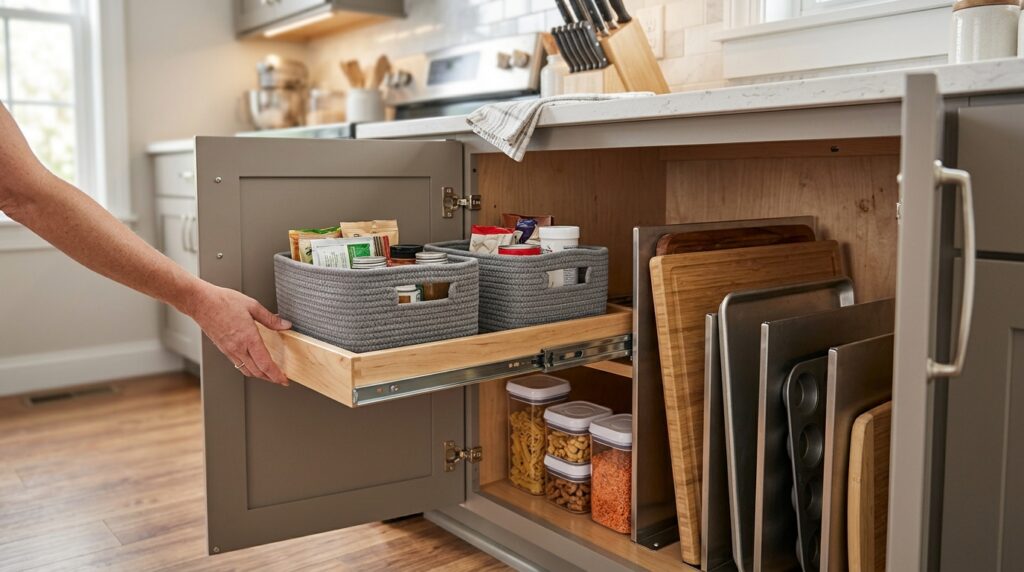
Flat baking sheets take up less space when they stand on edge. Use a divider that is anchored or heavy enough not to tip when you remove one pan. Keep the sheet you use most near the opening.
This also works for cooling racks and serving boards. If the cabinet floor has a lip, add a thin spacer so the dividers sit flat. A wobbly divider will scratch the shelf and eventually collapse into the pile it was meant to fix.
10. Finish with a five-minute closing reset
Storage only helps if the kitchen is easy to reset. Before I finish for the night, I return the oils to their tray, stand the board up to dry, put appliance accessories back in their container, and wipe the main prep zone. That takes less time than searching for a missing tool the next morning.
| Clutter you see | Likely cause | Storage fix |
|---|---|---|
| Tools beside the sink | No drying or storage zone | Upright board slot and small tray |
| Appliances in a row | No parking rule | Keep one out and store the rest by frequency |
| Seasonings everywhere | No boundary near the range | One washable bottle tray |
| Loose drawer tools | Too much open space | Low dividers grouped by task |
Try this counter-clutter self-check
Open the two-minute kitchen storage quiz
Question 1: Do you move the same item three times before using it? Store it closer to the task it supports.
Question 2: Does a storage piece need special handling to be put away? Simplify it or give it a larger landing zone.
Question 3: Is the counter crowded by something used less than once a week? Move it to a lower cabinet or pantry shelf.
Question 4: Can you clear the prep zone in five minutes? If not, remove one category before buying another organizer.
Make the system fit your real habits
The best storage idea is the one you can use with wet hands, a full grocery bag, or a tired brain at the end of the day. I would rather have one sturdy tray and a clear drawer than six clever products that need constant rearranging.
If the counter still feels crowded, look for a repeated task that lacks a home. That is usually the real source of the mess. My guides to installing pull-out cabinet shelves and fixing sticky kitchen drawers are useful next steps when the problem is deeper than the counter.
Build storage around one real cooking sequence
One useful test is to follow a meal from start to finish and watch where your hands travel. If you pull a pan from a low cabinet, cross the room for a spatula, and then reach behind the coffee machine for oil, the storage problem is a route problem. You can often fix it without remodeling by moving just three items.
For a weeknight stir-fry, I keep the pan, turner, oil tray, and heatproof spoon rest in the same working triangle. The pan stays below the cooktop, the turner lives in the shallow drawer beside it, and the oil tray sits far enough from the burner that bottles do not warm up. That arrangement saves more time than a large organizer filled with tools I rarely touch.
- Store by sequence: keep the measuring cup near the flour bin, not wherever an empty shelf happens to be.
- Protect clearances: leave space around hot appliances, sink edges, and the oven vent.
- Keep handles visible: a divider should stop tools from sliding, not bury them below the rim.
- Make cleaning easy: choose trays you can lift and organizers with open corners where crumbs cannot hide.
- Use one-handed actions: lids, bins, and hooks should work while the other hand holds a bowl or towel.
A 30-minute test before you buy organizers
Before spending money, clear one small zone and mark its edges with painter’s tape. Put back only the items used in that task. I use cardboard food boxes as temporary dividers, because they reveal whether a compartment is the right width before I commit to bamboo or acrylic.
- Measure the usable width, depth, and height inside the drawer or cabinet. Measure around hinges, slide hardware, and the cabinet face rather than trusting the outside dimension.
- Place the most-used items at the front or at waist height. Put backups behind them only if you can still remove the front item without unloading the shelf.
- Open the door or drawer ten times with normal hands. If the organizer catches, tips, or forces you to move another object, change the layout before buying anything.
- Cook one simple meal using the new zone. Notice whether you reach across a hot surface, set tools on the floor, or leave the cabinet open because the storage is awkward.
- After a week, keep the parts that make the task easier and remove anything that only looks tidy. Empty space is useful when it gives a hot pan, cutting board, or grocery bag a safe landing place.
Small kitchens benefit from forgiving storage. A tray that can be lifted, a hook that is easy to reach, and a drawer divider that can be moved later will serve you better than a fixed system designed around an idealized routine. I have changed the same cabinet twice as my cooking habits changed, and the inexpensive test pieces prevented two expensive mistakes.
Sources and safe-use notes
- USDA, How to Reduce Food Waste at Home. Visibility and using older food first are useful ideas for pantry and counter systems.
- Mounting and loading suggestions are general home-practice guidance. Check the instructions for your cabinet, wall material, and organizer before drilling or loading it.
Excerpt: Use practical storage zones, vertical organizers, and hidden landing spots to keep kitchen counters clear without losing daily essentials.
Primary keyword: smart kitchen storage ideas
Meta description: Use practical storage zones, vertical organizers, and hidden landing spots to keep kitchen counters clear without losing daily essentials.
Visual alt text 1: Small kitchen with clear counters and a rail-mounted utensil zone.
Visual alt text 2: Open cabinet with labeled storage zones, a pull-out bin, and a vertical tray divider.
Draft category: Kitchen Tips. Use the first visual as the featured image without caption text and place the second visual inside the article.
A clear counter is not an empty counter. It is a counter with room for the work you want to do.
Measure first, buy less, and test one small zone for a week before changing the whole kitchen. That small test tells you more than a basket full of organizers ever will.
Good storage protects the work surface as much as it stores the tools. Keep the space beside the sink clear enough to set down a hot pan or a full cutting board safely.
When the storage decision is obvious, putting things away stops feeling like a separate chore. That is when a kitchen starts to stay clear on its own.
Leave a Reply