If you buy whole coffee beans but grind them days before brewing, you are giving away one of the easiest ways to improve your cup. Grinding just before you brew helps preserve the aromas that make coffee taste fresh. The grinder also lets you match the particle size to your brewing method, which changes how quickly water extracts flavour.
That does not mean everyone needs an expensive machine. A basic burr grinder can make a noticeable difference if you brew coffee regularly, while a blade grinder may be enough for someone who only makes an occasional cup and is not chasing consistency. The best choice depends on your brewing style, budget, and willingness to clean another appliance.
Why grind coffee just before brewing?
Whole beans protect much of the coffee’s aroma from air and moisture. Once you grind them, you expose far more surface area to oxygen. Aromatic compounds escape and the coffee gradually loses some of its brightness and character. Ground coffee does not suddenly become bad, but it generally loses freshness faster than whole beans.
Grinding right before brewing reduces the time between breaking the beans and adding water. Store beans in an airtight container away from heat, sunlight, and moisture. You do not need a fancy vacuum canister, but leaving an open bag beside a warm stove is not ideal.
What grind size actually changes
Grind size affects how much coffee surface touches the water and how easily water moves through the coffee bed. Fine particles offer more exposed surface area and slow water flow in many brewing setups. Coarse particles expose less surface area and allow water to pass more easily.
If the grind is too fine for the method, the brew can run slowly and taste harsh, bitter, or overly dry. If it is too coarse, water may pass through too quickly and leave the cup thin, sour, or weak. These are useful clues, not fixed rules: roast level, bean variety, water temperature, brew ratio, and technique all affect the result.
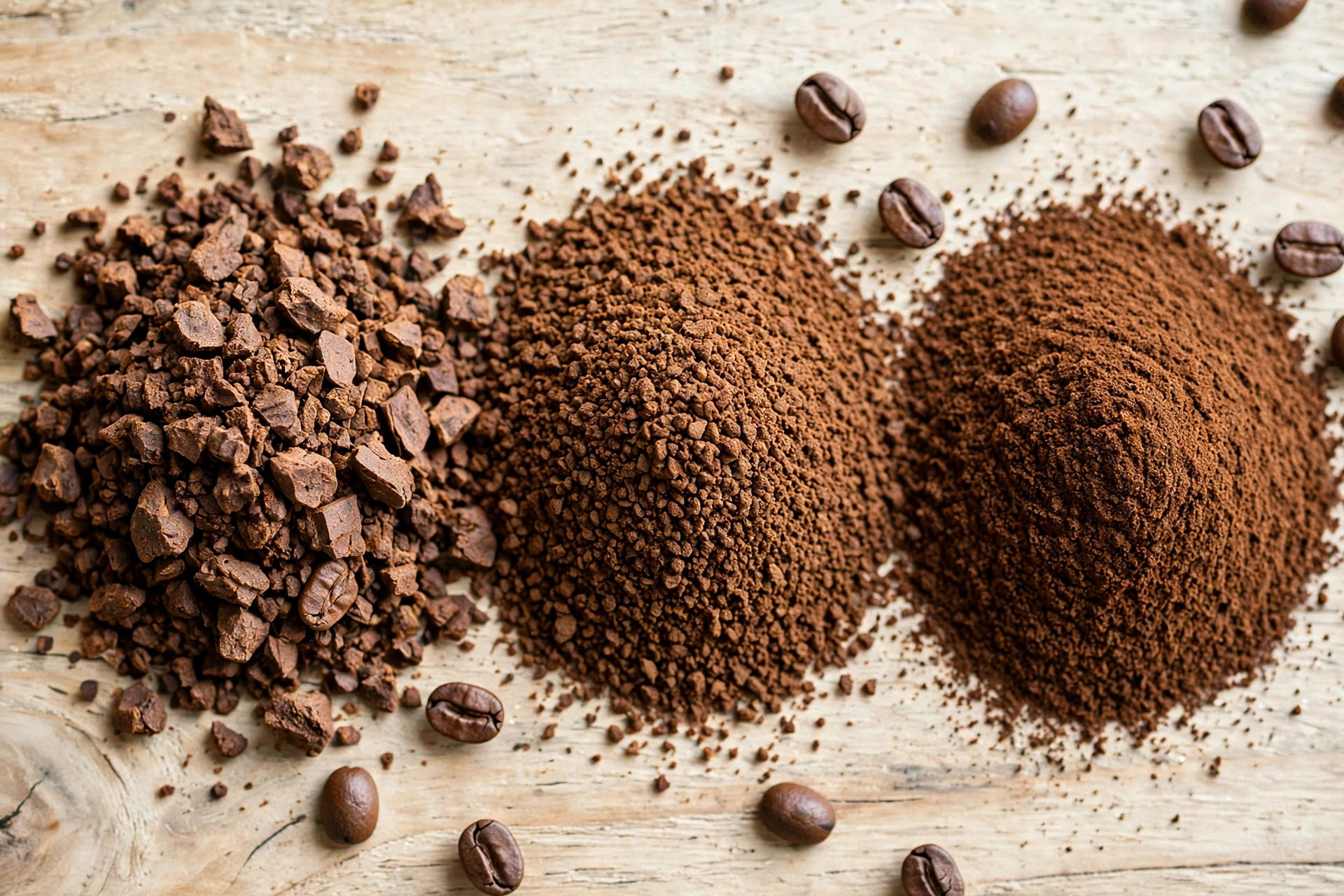
Grind size by brewing method
| Brewing method | Starting grind | What to look for |
|---|---|---|
| Espresso | Fine | Adjust until the shot flows at a sensible rate and tastes balanced. |
| Moka pot | Medium-fine | Usually finer than drip, but not packed espresso-fine. |
| Pour-over | Medium to medium-fine | Adjust for drawdown time and taste. |
| Drip machine | Medium | Follow the basket and brewer guidance, then tune to flavour. |
| AeroPress | Fine to medium | Recipe-dependent; steep time and pressure matter too. |
| French press | Coarse | Large, even particles help limit sediment and over-extraction. |
| Cold brew | Coarse | Coarse grounds are easier to filter after a long steep. |
These are starting points, not laws. Different brewers, filters, and recipes can call for different settings. Change one variable at a time and taste the result rather than trying to follow a grind chart as if every bean behaves the same.
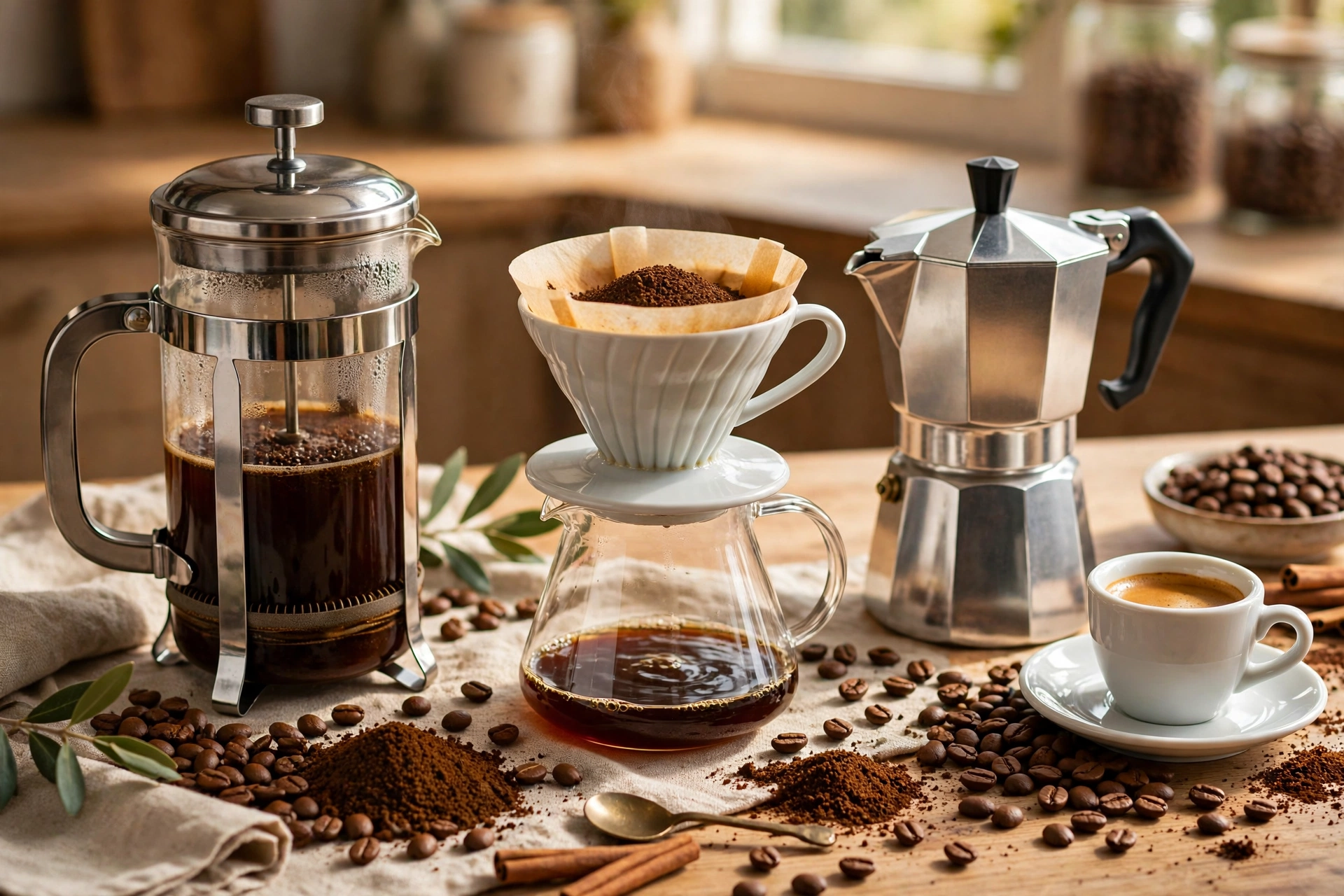
Blade grinder vs. burr grinder
A blade grinder uses a spinning blade to chop beans. It is usually inexpensive and compact. The downside is that it does not produce a very even grind. You can end up with a mix of fine dust and large pieces in the same batch, which makes extraction less predictable.
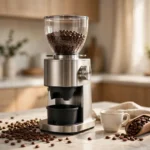
A burr grinder crushes beans between two abrasive surfaces. You adjust the gap between the burrs to change the particle size. A good burr grinder produces a more consistent grind and gives you finer control, especially when you switch between brewing methods.
Is a burr grinder always worth the extra cost?
If you make coffee every day, use a pour-over, espresso machine, or French press, and care about repeatable results, a burr grinder is usually worth considering. Consistency makes it easier to adjust a recipe and understand why a cup tastes different. It also reduces the frustration of trying to compensate for uneven particles.
If you mostly drink instant coffee, buy pre-ground coffee for convenience, or make an occasional cup with a forgiving brewer, you may not need a separate grinder. You can also ask a local roaster or coffee shop to grind a small amount for your brewing method, though the grounds will lose freshness faster than whole beans.
Flat burrs and conical burrs
Flat and conical burrs are two common designs. Both can produce excellent coffee. Flat burr grinders often create a particular distribution of particle sizes that some espresso drinkers prefer. Conical burr grinders are common in home machines and can offer good performance at a range of prices.
Do not choose only by burr shape. Burr quality, alignment, motor speed, adjustment range, retention, build quality, and ease of cleaning all matter. A well-made grinder with one burr style can outperform a poorly made grinder with the other.
What to check before buying a coffee grinder
- Adjustment range: Make sure it can reach the grind sizes you need. Espresso requires finer adjustment than most filter methods.
- Step size: Stepped grinders have set positions. Stepless grinders allow very small adjustments and can be useful for espresso, but may take more effort to dial in.
- Consistency: Look for tests and owner feedback that discuss particle uniformity, not just motor power or the number of settings.
- Retention: Some grounds remain inside the grinder after use. Low retention makes it easier to change beans and measure doses accurately.
- Capacity: Choose a hopper or dosing cup that suits how much coffee you make. A large hopper is not automatically better if you grind one cup at a time.
- Noise: Grinders can be loud. Check real-world comments if you brew early while others are sleeping.
- Cleaning: Find out whether the burrs can be accessed without special tools and how often the manufacturer recommends cleaning.
- Spare parts: Replaceable burrs and available service support can extend the grinder’s useful life.
How to dial in grind size at home
Start with the grinder’s suggested setting for your brew method. Use the same coffee dose, water amount, and brewing routine for each test. If the cup tastes sour, thin, or underdeveloped, try a slightly finer grind. If it tastes harsh, bitter, or drying, try a slightly coarser grind. Make small changes so you can tell what helped.
For pour-over and drip coffee, you can also watch the brew time. A grind that is too fine may slow the drawdown, while a very coarse grind may let water pass quickly. Do not chase a specific time at the expense of flavour; use timing as a clue alongside taste.
Espresso takes more adjustment because small grind changes can have a large effect on flow. Change the grind in small steps and keep the dose and yield consistent while you test. If you change the coffee, roast, dose, and grind at once, you will not know which change caused the result.
Do you need a separate grinder for each brew method?
Not necessarily. A capable grinder with a wide adjustment range can serve several methods, but switching between espresso and coarse French press settings may take time. Some grinders retain old grounds, so a small amount of the previous setting can end up in your next brew.
If you regularly switch methods, consider how easy it is to adjust and clean the grinder. Some people prefer one grinder for espresso and another for filter coffee. That is a convenience choice, not a requirement for making good coffee at home.
Cleaning and storing your grinder
Brush away loose grounds and clean the burr chamber as directed by the manufacturer. Do not wash electrical parts or burrs under running water unless the manual specifically permits it. Coffee oils build up over time and can turn stale, affecting the aroma of fresh beans.
Use grinder-cleaning pellets only if the manufacturer approves them. Avoid rice and other hard substitutes unless the manual explicitly allows them; they can put extra strain on some grinders. Empty old beans from the hopper if you will not use the grinder for a while, and keep the machine in a dry place.
Common coffee-grinding mistakes
- Grinding too far ahead: Grind close to brew time to keep more aroma in the cup.
- Changing too many variables: Adjust grind size first while keeping dose and water consistent.
- Assuming finer is stronger: A finer grind changes extraction and flow; it does not simply add more coffee flavour.
- Ignoring the brew method: Espresso and French press need very different particle sizes.
- Neglecting cleaning: Old grounds and oils can affect the taste of fresh coffee.
- Buying by settings count alone: A hundred adjustment labels do not guarantee an even grind or useful range.
Is a coffee grinder worth it for you?
A grinder makes the most sense if you buy whole beans, brew often, and want control over flavour. A burr grinder is the better long-term choice for most coffee enthusiasts because it produces a more even grind and gives you useful adjustments. A blade grinder is a low-cost entry point, but it is less consistent.
If convenience matters more than experimenting, pre-ground coffee can still make a perfectly enjoyable cup. Buy it in quantities you can use while it is fresh and store it well. You do not have to turn coffee into a hobby to enjoy it.
Find a starting grind for your brew
Coffee grind selector
Open your brewing method to see a sensible starting point. Adjust after tasting.
Espresso machine
Start fine. Adjust in small steps to control shot flow and taste.
Pour-over or drip machine
Start around medium. Go finer if the cup is thin and sour, or coarser if it is harsh and slow to drain.
French press
Start coarse with fairly even particles. Adjust steep time and grind together only after tasting the first brew.
Moka pot
Start medium-fine, usually a little coarser than espresso. Do not tamp the basket unless your brewer instructions say otherwise.
Cold brew
Start coarse so the grounds are easier to filter after the long steep.
Grind charts are starting points. Let the flavour in your cup guide the next small adjustment.
Final thoughts
A coffee grinder is worth buying when you want fresher grounds and more control over extraction. For most people who brew whole beans regularly, a good burr grinder offers the best balance of consistency and flexibility. Match the adjustment range to your brewer, keep the grinder clean, and make small changes as you learn what tastes best. You can also keep your brewer fresh with our guide to cleaning and maintaining a coffee maker.
Burr Grinder vs. Blade Grinder
A burr grinder crushes beans between two grinding surfaces and generally produces a more consistent particle distribution than a basic blade grinder. A blade grinder chops beans with a spinning blade, so particle sizes can vary more. That variation can make extraction less even, especially for pour-over, espresso, and other methods where grind consistency matters. A blade grinder can still be adequate for occasional immersion brewing if budget and simplicity matter more than precision.
For espresso, check whether the grinder has sufficiently fine adjustment and whether the steps are small enough for dialing in a shot. For French press, filter coffee, and cold brew, the useful grind range and consistency matter more than a large number of marketing presets. A grinder described as suitable for espresso may still not offer the adjustment range or stability required for every espresso machine.
Freshness, Dose, and Cleaning
Grind close to brewing time when possible, and store whole beans in an airtight container away from heat, light, and moisture. Measure coffee and water consistently when comparing grind settings; changing the dose at the same time makes it difficult to identify what improved the cup. If coffee tastes sour and thin, a finer grind or longer contact time may help; if it tastes harsh and bitter, a coarser grind or shorter contact time may be worth testing. These are starting points, not universal rules, because roast, water, brewer design, and recipe all matter.
Clean the burr chamber and grounds chute according to the grinder manual. Unplug the appliance before cleaning, do not rinse electrical parts, and avoid rice or other improvised cleaning materials unless the manufacturer specifically approves them. Retained oily grounds can become stale and affect flavor, while aggressive disassembly can damage alignment or void a warranty.
Manufacturer and safety references
These authoritative resources support the care, safety, or product-information points discussed above. Always follow the current instructions for your exact model.
How this guide was researched
This guide compares grinder types and brewing considerations using published product information, manufacturer documentation, and coffee-brewing guidance from recognized industry sources. Specific grinder capabilities vary by model, so check the current manufacturer specifications and instructions before purchase or cleaning.
Leave a Reply